
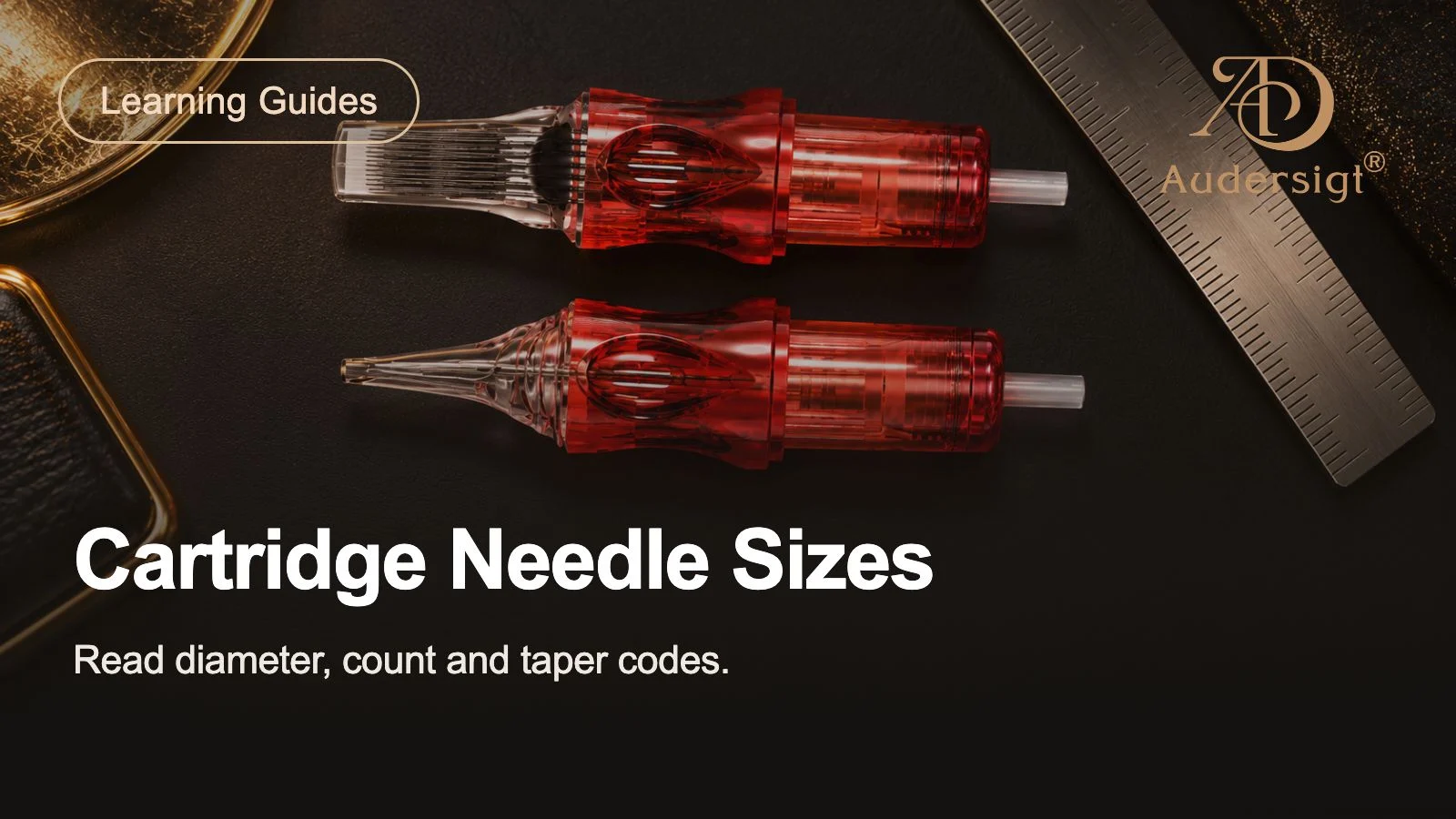
A tattoo cartridge size is more than its needle count. Read the configuration, number of individual needles, needle diameter and taper together. Then check the exact product option and packaging. Two cartridges described as “7RL” can share a count and configuration while differing in diameter or taper.
This guide explains how to read and compare specifications. It does not prescribe a cartridge, machine setting or technique for a particular person's skin. For the arrangement of the needles and the differences between RL, RS, M1 and RM, continue to needle configurations explained.
Read the label in separate parts
| Field | What it describes | What it does not establish |
|---|---|---|
| Needle count | Number of individual needles in the grouping | Finished line width or suitability for a specific design |
| Diameter | Thickness of each individual needle, normally stated in millimeters | Overall width of the complete grouping |
| Configuration | Arrangement, such as round liner or curved magnum | A guaranteed result or universal technique |
| Taper | The narrowing section of the needle point | A standard length shared by every manufacturer using the same label |
| Cartridge series | The manufacturer's particular housing and needle system | Compatibility with every machine |
Use the millimeter diameter wherever the manufacturer provides it. Short numeric codes can vary by supplier, and some labels use the diameter directly while others use a gauge-style prefix.
Work through a real product option
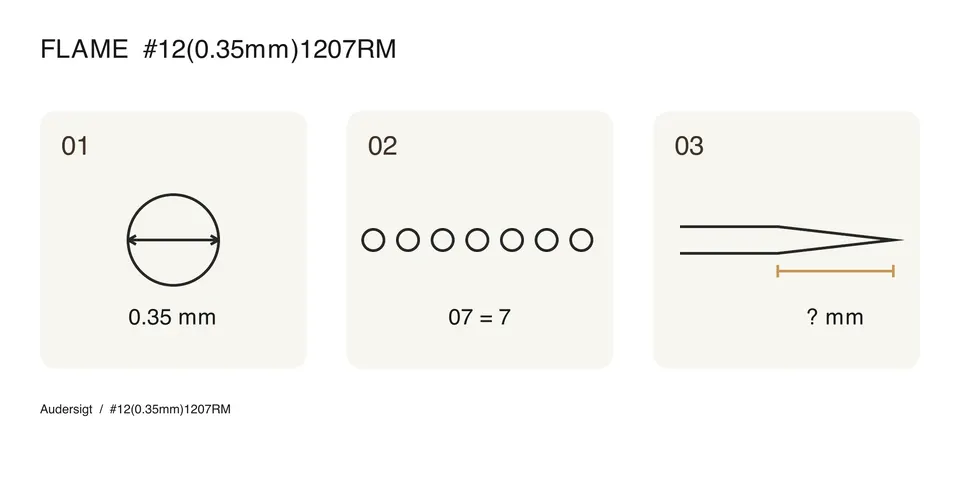
The current Audersigt FLAME curved magnum page displays an option written as “#12(0.35mm)1207RM.” In that option, the supplier explicitly pairs #12 with a 0.35 mm diameter; 07 identifies the needle count; RM identifies the curved magnum configuration.
That example explains the code shown on this product. It does not mean every supplier prints codes in the same sequence, and it does not establish that every diameter mentioned in general product copy is currently selectable. Match the option on the order to the label on the received box.
A clear purchasing line therefore records “FLAME, 0.35 mm, 7 needles, RM” along with the supplier's exact SKU or option code. Keeping both the readable description and original code makes substitution errors easier to detect.
Compare diameters without promising a line width
Diameter describes one needle, not the width of the finished tattoo line. Count, arrangement, taper and the rest of the setup also affect the working result. A diameter number alone should not be used to promise a particular outcome.
Manufacturer catalogs illustrate why complete descriptions matter. Cheyenne's cartridge specifications list diameter and taper choices separately. Kwadron's Round Liner Medium Taper product includes both diameter and taper in its product identity. These are examples of those brands' labeling, not evidence that their cartridges and Audersigt cartridges are interchangeable.
When comparing two options, first hold count and configuration constant, then compare the stated diameter and taper. If one field is missing, ask the supplier instead of assuming the products match.
Keep configuration separate from size
RL means round liner and RS means round shader. M1 and RM identify different magnum arrangements in many catalogs, but the manufacturer's diagram or description is the final reference for that series.
A count such as seven does not describe how those needles are arranged. That is why a stock list should not contain a single row named “7 needle.” Keep separate records for the full configuration and diameter, and use the configuration guide when deciding which structures need to be compared.
Check the actual FLAME options
Use the FLAME round liner page and FLAME curved magnum page to inspect the currently selectable options. Do not infer availability from a photograph of several boxes or from a general family description.
Before ordering, record:
- The exact series and configuration.
- The selected count and diameter.
- The taper information supplied for that option.
- Pack quantity and the number of packs required.
- The machine or grip compatibility statement supplied by the manufacturer.
- Any specification discrepancy that support still needs to resolve.
Product copy can contain conflicting material or certification statements. This guide does not resolve those conflicts by choosing the more favorable claim. Request the relevant product documentation when that information affects a purchasing decision.
Build inventory from actual use
There is no universal number of cartridge SKUs a studio should stock. Start with the configurations used by the studio's artists and record consumption by complete code. Separate frequently used stock from items ordered for a particular project.
A useful inventory sheet has columns for series, code, configuration, diameter, taper, pack quantity, available stock, expiry information where supplied, supplier and reorder decision. Keep an artist's preference or project requirement separate from the supplier's specification.
When a substitute is proposed, compare every field instead of treating a matching needle count as approval. Link the purchasing record to the exact product option so another person can check it without reconstructing the choice.
Inspect the received packaging
Match the received code and quantity to the order. Read the manufacturer's packaging, storage, expiry and single-use instructions. If a seal is damaged, a label is unreadable or the received item differs from the order, set it aside for the supplier's resolution process; do not treat a printed date as evidence that damaged packaging is acceptable.
Keep receiving discrepancies out of normal ready-to-use stock. Do not invent a secondary use for a damaged or expired cartridge merely to avoid discarding it. The manufacturer's instructions and the studio's applicable procedures determine handling and disposal.
Questions the size code cannot answer
**Does a higher count require a specific voltage or stroke?** A cartridge label is not an operating instruction. Use the machine and cartridge manufacturers' instructions and the studio's professional review; there is no universal setting derivable from the count alone.
**Are two 7RL cartridges equivalent?** Only if the relevant specifications and intended compatibility have been checked. A shared short name is not enough.
**Does a box description prove all sizes are in stock?** No. Check the selected option and order confirmation.
**Where should I start a comparison?** Write the full code in plain language, compare the product specifications, and resolve missing fields before purchasing. Use the cartridge collection for current options and the studio supply checklist for inventory planning.
Related resources
Tattoo cartridge catalogCompatible machine setupsCommon questions
What information should a cartridge code record?
Record the grouping, diameter or gauge, taper where supplied, configuration, membrane or compatibility notes, lot information, and the machine setup used for the comparison.
Should cartridge size be selected by a single chart?
Use a chart as a reference, then verify the complete cartridge code, intended task, material, machine response, and controlled practice result before standardizing the setup.
Find your next tattoo setup
Shop productsRelated Articles
Tattoo Machine Stroke Guide
Learn how tattoo machine stroke length affects lining, shading, color packing, needle control, and daily studio setup decisions.
Fine Line Tattoo Station Setup
Plan a fine line tattoo station around artwork scale, stencil clarity, a documented machine and cartridge baseline, stable lighting, and controlled practice review.
Wholesale Tattoo Supply Buying Guide
Evaluate wholesale tattoo supply orders through verified specifications, samples, landed cost, lead time, receiving checks, and reorder data.