
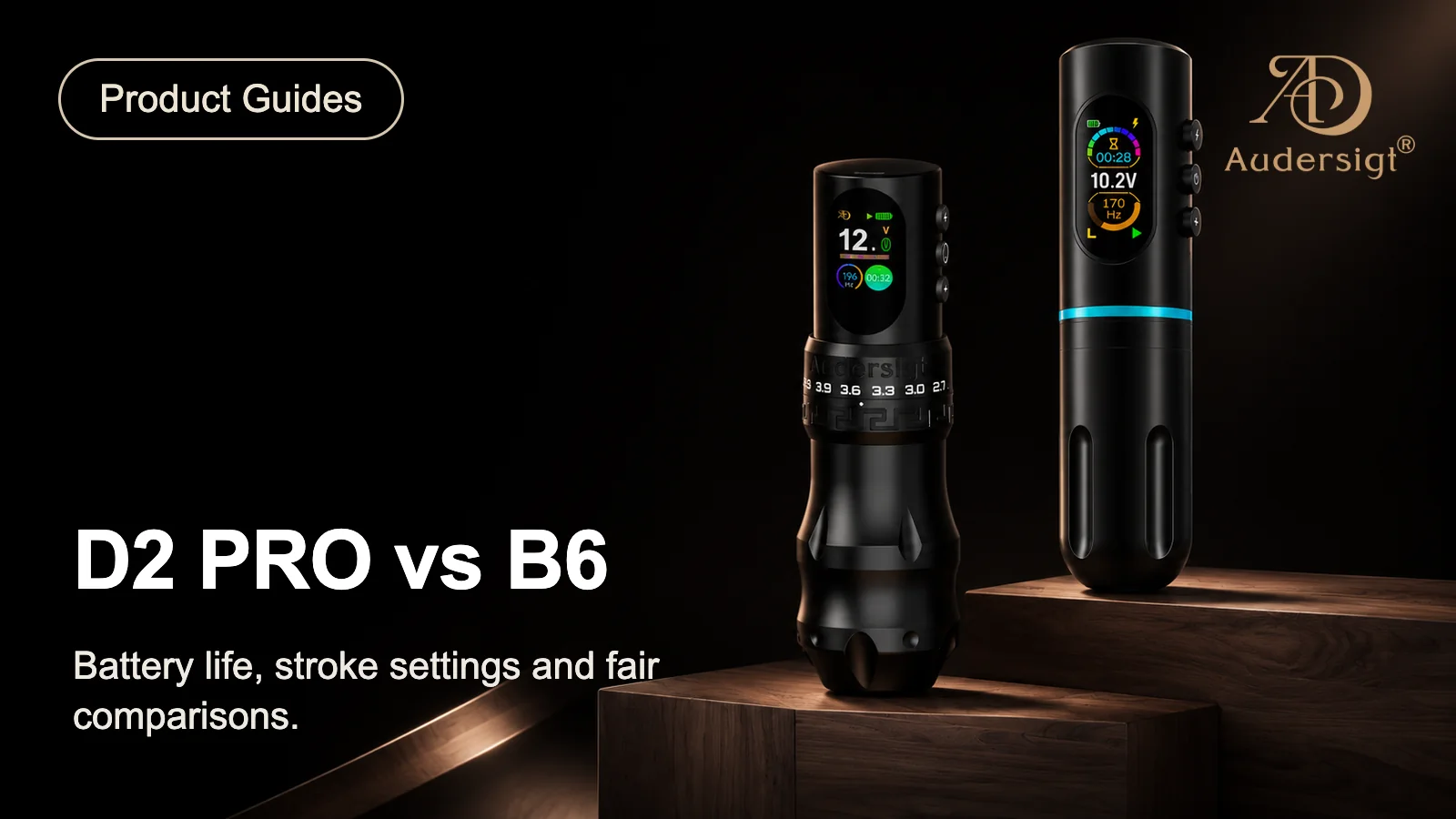
The Audersigt D2 PRO and B6 list different battery capacities and estimated runtimes. Those figures are useful for planning, but they do not establish which machine is more efficient or delivers more useful output.
Runtime depends on usable battery energy and average electrical demand. Stroke settings, motor operation, cartridge resistance and control electronics all affect that demand. This guide separates published product facts from engineering explanations and shows what a fair comparison would need.
D2 PRO and B6: The Published Specifications
The current D2 PRO product page and B6 product page provide the following reference information.
| Specification | D2 PRO | B6 / KT086 |
|---|---|---|
| Stroke | 2.7–4.5 mm, seven settings | Fixed 4.0 mm |
| Motor | ZEUS V3 coreless motor | Coreless motor |
| Capacity per battery | 1800 mAh | 2000 mAh |
| Published runtime estimate | About 5–8 hours | About 6–8 hours |
| Machine output voltage | 4–12 V | 4–12 V |
| Listed power arrangement | Removable battery; spare battery listed | Removable battery; spare battery and RCA adapter listed |
These ranges are manufacturer estimates, not a controlled head-to-head test. Check the selected package and current instructions. Two batteries supplied together do not make the capacity or uninterrupted runtime of one battery twice as large.
The B6's nominal mAh figure is about 11.1% higher: (2000 − 1800) ÷ 1800 × 100. That is a capacity comparison, not an efficiency score or a promised runtime gain. Converting it into an energy comparison also requires the batteries' nominal voltages.
Battery Energy and Average Power Explain Runtime
A useful simplified relationship is:
Runtime (h) ≈ usable battery energy (Wh) ÷ average battery-side input power (W).
Use the same measurement boundary: energy available from the battery and average electrical power drawn from that battery. Nominal energy can be estimated from nominal battery voltage × capacity in Ah; usable energy also depends on cutoff, battery health, temperature and discharge load.
The 4–12 V machine setting is not the battery's nominal cell voltage. Do not use it to convert a mAh label into Wh.
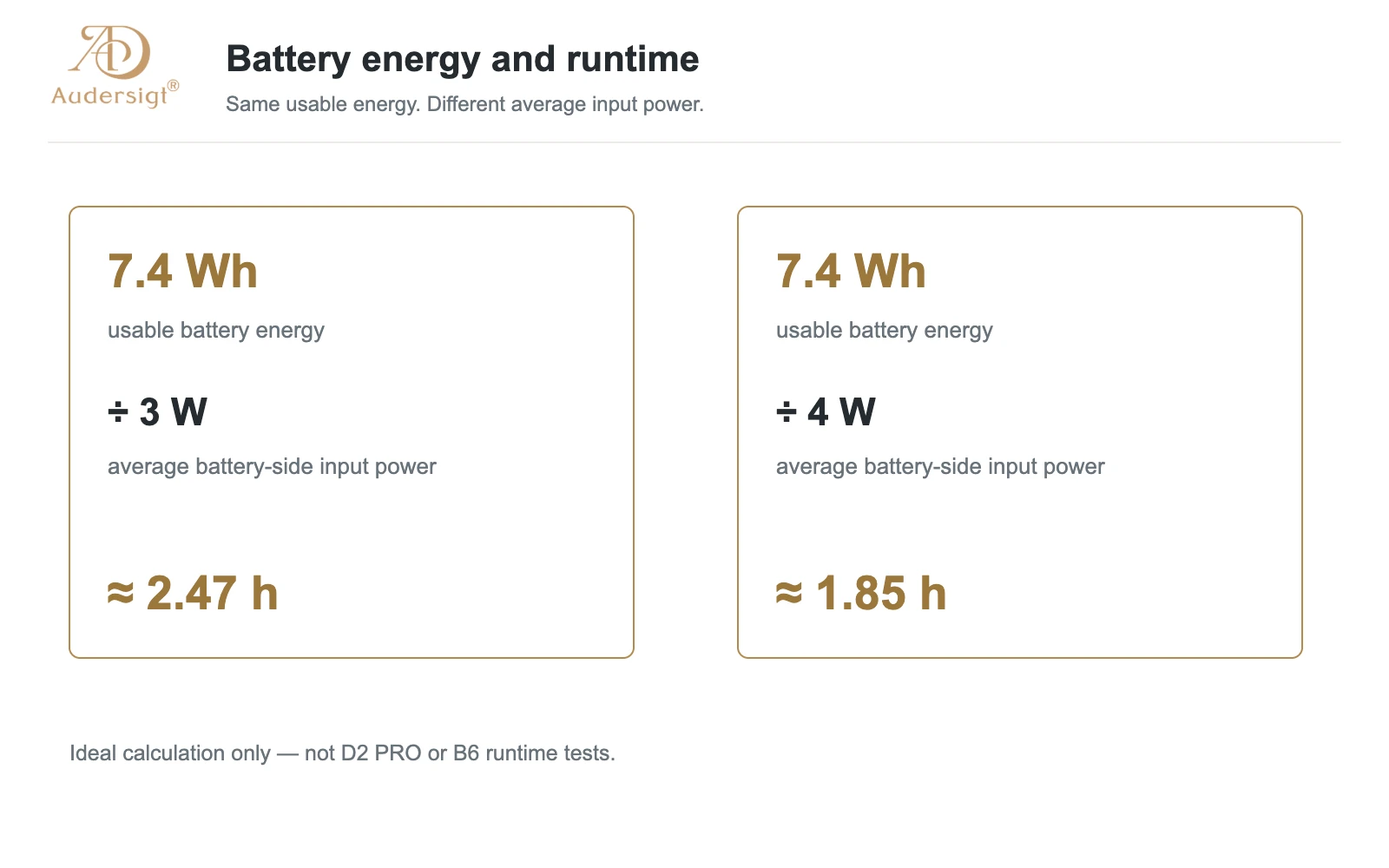
Consider two hypothetical systems, each with 7.4 Wh of usable energy:
| Illustrative system | Average battery input | Calculated continuous runtime |
|---|---|---|
| A | 3 W | 2.47 h |
| B | 4 W | 1.85 h |
These numbers are not D2 PRO or B6 measurements. System B runs for less time because its average input is higher; this calculation says nothing about how much useful output either system produces.
Torque Capability Is Different from Operating Load
Torque is the turning effect at the motor shaft. Sufficient torque helps the drive overcome cartridge membrane resistance and other mechanical loads. A motor's available torque is different from the torque it actually produces during a particular task.
For many permanent-magnet motors, torque-producing current and electromagnetic torque are related. Higher current can increase winding heat. The actual relationship depends on motor design and control; no model-specific torque-current or efficiency curves are supplied by this comparison.
Compare the output as well as the input
Imagine one controller drawing more current to maintain speed as resistance rises, while another allows speed to fall. Their runtimes cannot be treated as an efficiency comparison if the delivered movement differs. These are hypothetical control responses, not documented operating modes of D2 PRO or B6.
Mechanical shaft power depends on torque and rotational speed. Motor efficiency is mechanical output power divided by motor electrical input, multiplied by 100. Battery-side demand additionally includes the controller, voltage conversion, display and other circuitry. A shorter runtime alone does not prove stronger output; a longer runtime alone does not prove higher efficiency.
Precision Helps Control Avoidable Losses
Alignment, bearing condition, clearances and assembly affect friction, vibration and wear. Good manufacturing and controlled assembly can reduce avoidable losses; they do not inherently shorten battery life.
Tighter is not automatically better. Excessive preload can increase friction and heating, as explained in NSK's bearing-preload reference. This is general engineering context, not evidence of a fault in either machine.
A spring can store and return energy during a cycle. Its presence alone does not establish a constant extra power cost. Friction, damping and the complete control strategy determine the resulting losses. The D2 PRO catalogue's built-in rebound-structure description does not quantify energy consumption or recovery.
Adjustable Stroke and Direct Drive Are Different Questions
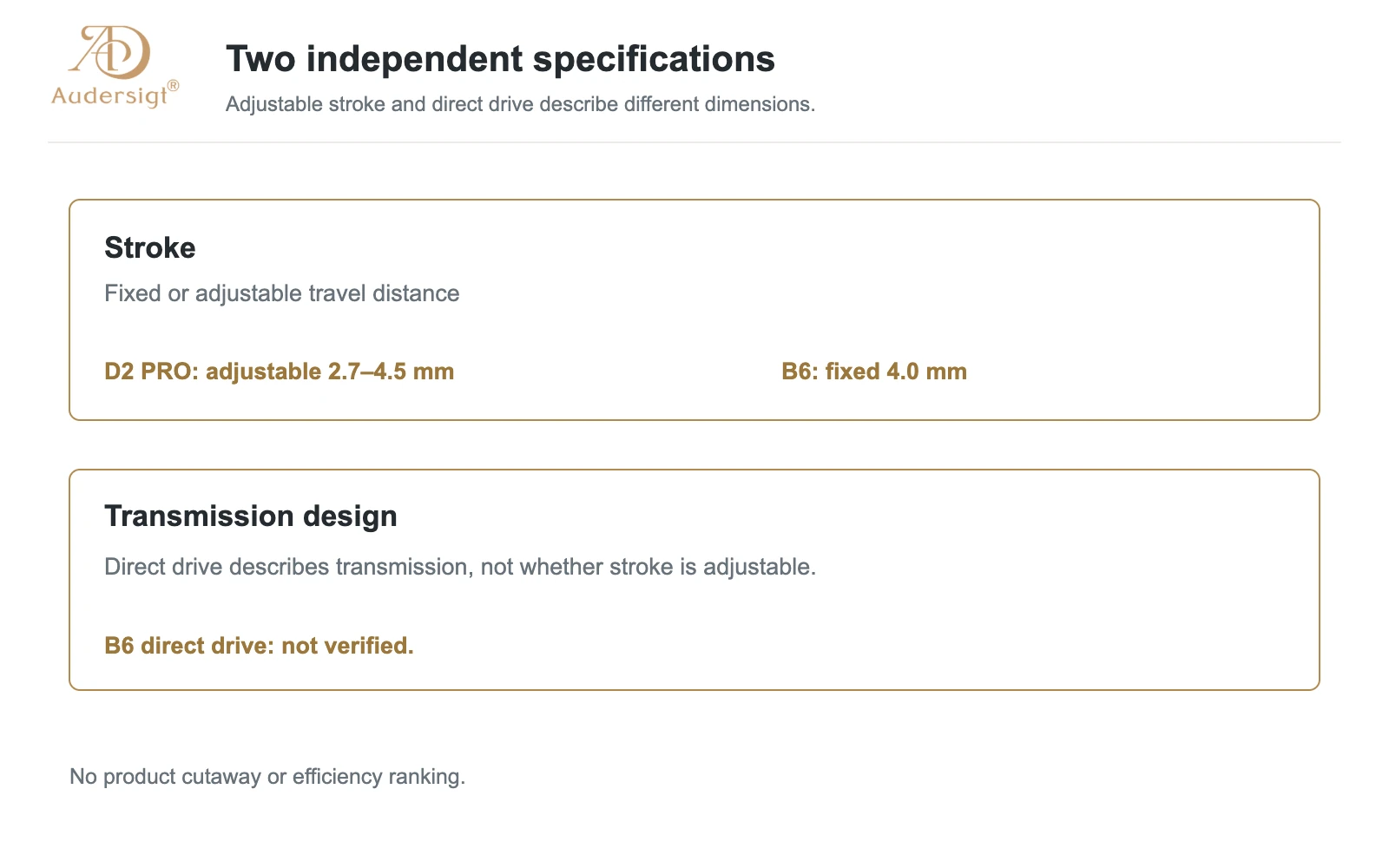
Adjustable stroke describes whether travel distance can change. Direct drive describes the transmission arrangement. A design may combine both. A fixed-stroke label by itself does not identify the internal drive.
The D2 PRO offers 2.7 / 3.0 / 3.3 / 3.6 / 3.9 / 4.2 / 4.5 mm settings. Changing the geometry can alter moving mass, inertia, friction interfaces and load distribution, depending on the design. An adjustment mechanism does not automatically impose a particular energy penalty.
What is established about the B6?
The current product information establishes a fixed 4.0 mm stroke and a coreless motor. It does not provide an internal transmission schematic. This article does not classify the B6 as verified direct drive or assign it a measured mechanical-efficiency advantage. Any generic discussion of simpler direct-drive mechanisms is separate from these product facts.
For actual D2 controls, see the D2 PRO seven-setting adjustment guide. The broader stroke guide separates stroke, needle protrusion and penetration depth.
Stroke, Cartridges and Electronics Change the Load
At a fixed cycle frequency, a longer stroke increases travel per second. It can also change moving-part speed, acceleration and the geometry relating shaft torque to needle-driving force. Actual consumption still depends on the complete mechanism and load; a longer stroke is not automatically more power-hungry in every situation.
Cartridge membrane characteristics, guidance and needle grouping affect resistance. Even matching needle counts do not establish identical cartridge loads. Compare the same model where possible and document any differences.
Speed regulation, startup behaviour, conversion losses and display demand also contribute. Comparing machines at the same voltage does not guarantee the same actual reciprocation frequency or useful output.
What a Fair Comparison Needs
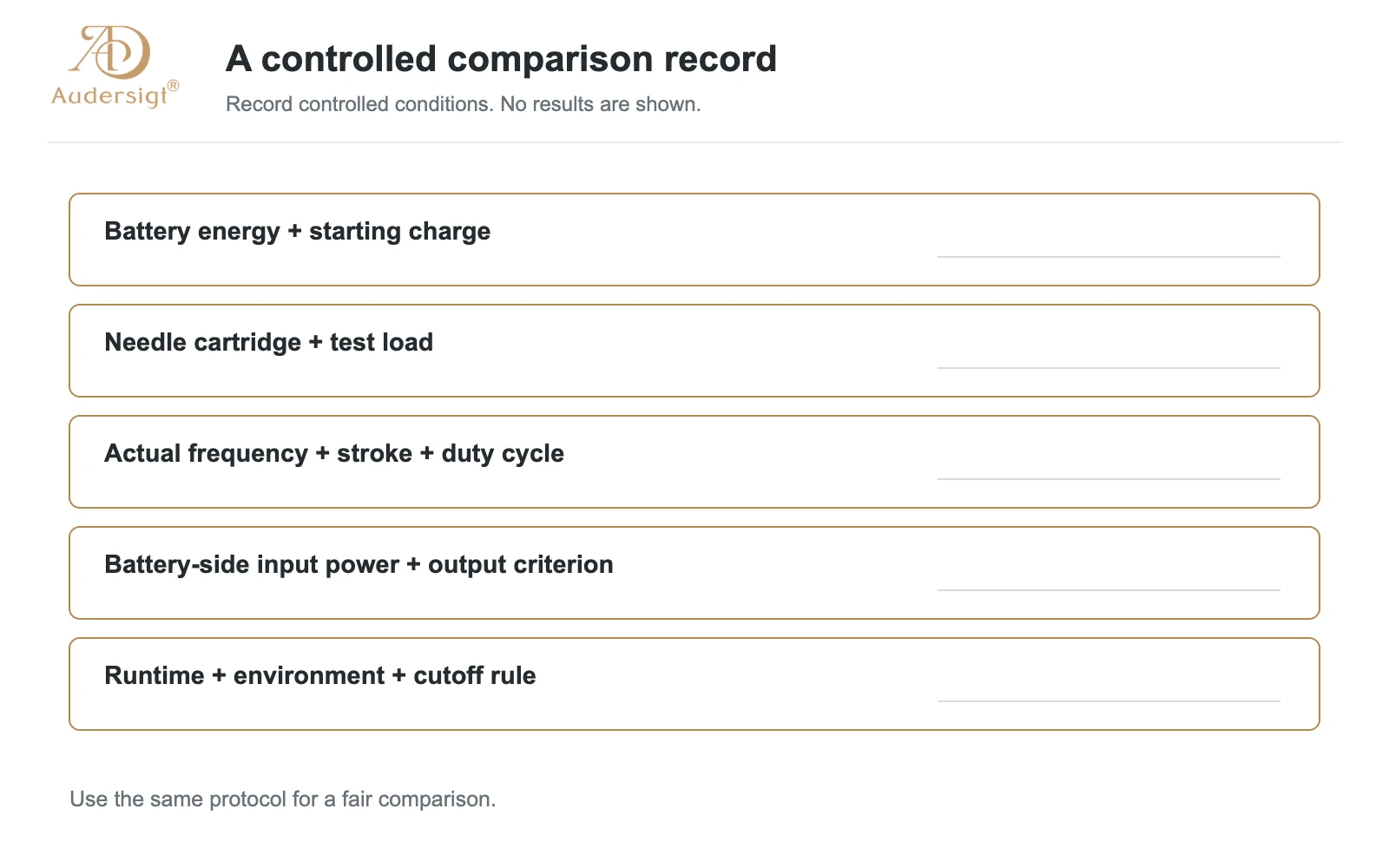
A complete-machine runtime test should document:
- Battery energy: usable Wh, battery health, charge state, temperature and cutoff conditions.
- Cartridge and load: cartridge model, grouping and a repeatable test load.
- Actual frequency: measured movement rate, not only a voltage setting or a motor's maximum RPM label.
- Stroke: the selected setting and any mismatch between machines.
- Electrical input: average battery-side voltage, current and power over the same boundary.
- Output and stability: maintained frequency, load response, temperature and vibration.
- Timing: continuous operation or a defined work/rest pattern, plus the same stopping criterion.
The B6 is fixed at 4.0 mm; the nearest D2 PRO settings are 3.9 and 4.2 mm. Neither is an exact stroke match. Record the difference rather than describing the test as identical.
A battery rundown compares the complete system. Separating motor efficiency from transmission losses additionally requires measurements at the relevant mechanical interfaces. Appropriate technical testing should follow the manufacturer's instructions; do not open a battery pack or dismantle a machine to recreate these illustrations.
Choose a Configuration, Then Check Its Runtime
The D2 PRO provides several selectable stroke positions. The B6 provides one fixed-stroke configuration and a documented removable-battery/RCA arrangement. Consider those differences alongside grip, balance, compatible cartridges and your charging or backup plan.
Use published runtime ranges as planning references, then evaluate the configuration under relevant, documented conditions. The available specifications do not establish an overall efficiency winner. This article provides no fixed working voltage, recommended penetration depth or prediction of healed results.
Explore the D2 PRO and its current package options, or view the B6 and its included power options.
Product information checked on November 9, 2026. Engineering background: OMRON motor terminology and NSK preload guidance. These references do not test or certify Audersigt products.
Common Battery-Life Questions
Does 2000 mAh guarantee 11.1% more runtime than 1800 mAh?
No. The percentage compares nominal charge capacity. Energy also depends on battery voltage, while runtime depends on usable energy, average demand and test conditions.
Do the 5–8 and 6–8 hour ranges prove the B6 is more efficient?
No. The ranges overlap and are published estimates. There is no controlled, equivalent-output comparison here.
Do adjustable-stroke machines always use more power?
No. Adjustment capability does not quantify friction, motor efficiency or the actual operating load. Compare documented designs and measurements.
Can two supplied batteries be counted as one battery's runtime?
No. A spare supports battery changes and workflow planning; it does not double one module's capacity or uninterrupted operating time.
Can I use the 4–12 V setting to calculate battery energy?
No. That setting is the machine's output, not a documented nominal battery voltage. Use the manufacturer's battery-energy information or appropriate technical measurements.
Find your next tattoo setup
Shop productsRelated Articles

Best Tattoo Stencil Printers: X6 vs T08FD
Compare the Audersigt X6 and T08FD tattoo stencil printers by paper support, connectivity, battery, controls, size, and real studio workflow.

Best Wireless Tattoo Machines: A Specification-Led Studio Guide
Compare Audersigt D2 Pro, KT088, KT108 and MAX PRO by documented stroke, battery and grip configurations, with a practical buying checklist.

Tattoo Machine Stroke Guide
Understand stroke, needle protrusion and depth, then compare machine settings, cartridges and power systems without relying on a universal setup chart.